Updated November 3, 2026
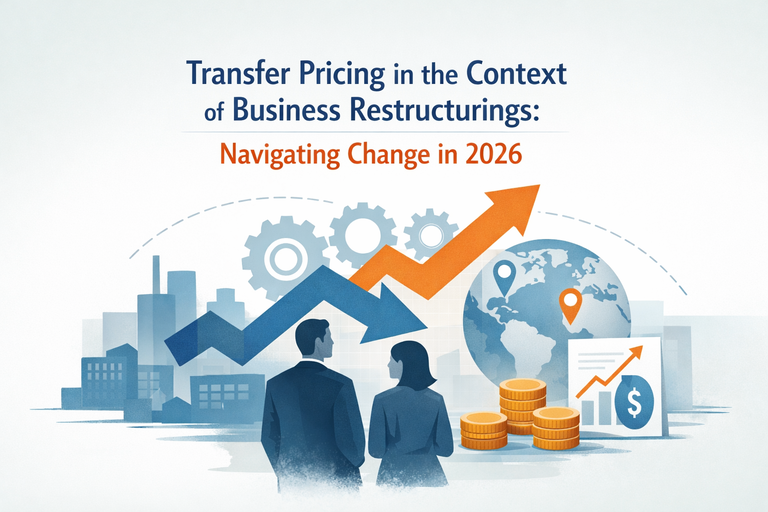
Business restructurings require a transfer pricing review when related companies change their commercial arrangements, transfer assets or rights, or reorganize responsibilities. Evaluate both the restructuring transaction and the pricing of subsequent intercompany dealings.
A reduction in an entity’s expected profits does not automatically establish a right to compensation. OECD Guidelines, Chapter IX
What Should You Examine Before a Restructuring?
Map what will change and what will remain:
- Functions performed and decision-making authority.
- Assets, intellectual property, and contractual rights.
- Risks assumed and the ability to control them.
- Customer, supplier, and intercompany arrangements.
- Expected financial results and commercial alternatives.
Use this review to identify the transactions requiring analysis, rather than treating the restructuring as a single accounting entry.
When Might Compensation Be Required?
Compensation may arise from a transfer of something valuable or from terminating or substantially renegotiating an arrangement where independent parties would require indemnification.
Review the contractual rights, actual circumstances, applicable law, and realistically available alternatives.
A fall in profit potential alone does not automatically require an exit payment. Likewise, shifting responsibilities does not establish a compensation amount without identifying and evaluating the relevant transaction. OECD Guidelines, paragraphs 9.39–9.40 and Section F
Example: Converting a Distributor to a Limited-Risk Model
Consider a hypothetical group proposing to centralize inventory and pricing decisions.
| Area | Before | Proposed After |
|---|---|---|
| Inventory | Local distributor owns inventory | Central principal owns inventory |
| Pricing decisions | Local management sets prices | Principal directs pricing |
| Customer activity | Local distributor manages sales | Local team continues defined sales activities |
| Risk decisions | Local entity controls specified risks | Principal is intended to control those risks |
| Compensation | Existing distribution return | Revised return requiring economic support |
The proposed contract is not proof that these changes occurred.
Validate actual decision-making, retained activities, transferred rights, and each entity’s capacity to perform its new role. Then assess separately whether compensation is due for the change and how future transactions should be priced.
This example illustrates a review process, not a conclusion that compensation or a particular margin is required.
How Should Post-Restructuring Transactions Be Priced?
Review the revised goods, services, financing, and IP arrangements against the entities’ actual roles.
U.S. Section 482 rules generally require related-party outcomes consistent with comparable independent-party transactions. A new label such as “limited-risk distributor” does not replace the required analysis. IRS transfer pricing guidance
Keep Valuation and Other Tax Reviews Separate
Where value is transferred, document the valuation assumptions, forecasts, and rights being valued. Do not assume a balance-sheet amount represents an appropriate transfer price.
Also obtain advice on other consequences, including potential exit taxation, withholding, indirect taxes, customs, and reporting.
For U.S. taxpayers, certain transfers of property to foreign corporations can require Form 926. Not every restructuring triggers this form. IRS Form 926 instructions
Practical Restructuring Checklist
- Record the commercial rationale and alternatives considered.
- Prepare a before-and-after functional analysis.
- Identify transferred assets, rights, and changed agreements.
- Assess compensation and obtain valuation support where appropriate.
- Review jurisdiction-specific tax and reporting requirements.
- Update agreements, systems, and ongoing pricing controls.
- Preserve approvals and evidence of actual implementation.
Read Transfer Pricing Implementation for guidance on putting the revised policy into operation.
Discuss Your Restructuring Plans
Explore WTP Advisors’ transfer pricing services and international valuation services before implementing material changes.
This article provides general information, not individualized tax or legal advice. Outcomes depend on the transaction, jurisdiction, and circumstances.